
My great grandmother used to say that she didn’t need to travel because she could experience the entire world through books. Books provide a gateway into any experience you wish. And if you don’t have the means to travel, then they are a worthy substitute. After a late night enterprise through internet maps, I have come to believe that internet maps and a search engine can also be a temporary substitute to fuel the adventurous spirit while you await the resources or time to go off on your own big adventure.
My internet adventure began with watching “A Four Day Kayaking Adventure to Work” by Beau Miles on YouTube (link to vid). Beau Miles is an adventurer, and a kind of a unique one at that because he makes a point of doing a lot of his adventures in his own backyard. He does typically mundane things from a new perspective, like commuting to work in a kayak. I recommend everything he does, it’s fantastic. His video inspired me so much that I spent the next several hours looking for adventures of my own.
Part 1: The Watersheds
I began my pseudo-adventure by dragging through the Ontario watershed maps. Watersheds are geographical areas where all the water is driven by gravity to go towards a certain body of water. As you zoom in, watersheds can be divided into smaller and smaller areas where the water collects to smaller rivers and creeks. The largest are called primary watersheds, then secondary, tertiary, and quaternary. The entirety of Southern Ontario is part of the Great Lakes to St. Lawrence river primary watershed, where the water eventually (if it doesn’t evaporate or get stuck somewhere) reaches the ocean. The major secondary watershed in Southwestern Ontario, where I’m from, drains into Lake Erie.
When I was tracing through my local watersheds, I found this idiosyncratic feature. The place where I live, London, is just North of the great Lake Erie where the water is ends up. But, the river that passes through our city, the Thames (you may notice a British theme), weaves curiously along the shore of Lake Erie, never touching it. Instead, a drop of water from London will travel about 150 km southwest into Lake St. Clair, then down the Detroit river, and then finally depositing into Lake Erie. What a journey!

With a weird sort of fascination at this, an idea for my own “backyard” adventure developed. Wouldn’t it be interesting to see Southwestern Ontario like that drop of water? A plan formed. I would start from a creek that runs through my fiancée’s family farm, then join the Thames, and follow its current down to Lake St. Clair. There was only one small problem with this plan: I didn’t have a boat.
Fast forward about 8 months after coming up with this idea. In the same creek where I was planning to start the journey (fiancée’s family farm), we found a very broken canoe stuck in some trees by the bank of the river after a storm! What are the chances? A means of travel, as if the universe meant for me to complete this trip. So I swam across the river to retrieve the canoe. I decided to pole my way back with a long branch. I sat in the boat, and once I broke it in (the seat immediately broke in half), it didn’t seem so bad other than the broken prow and the holes slowly leaking with water. About half way across the river, I tried sticking my pole on the downstream side of the boat (rookie poling mistake I guess), and immediately had to drop the pole as the boat went over it. After splashing my way towards the other side and getting caught by my fiancée, I managed to safely come ashore, beaming with my brand new broken, old canoe like a dog with a bone.
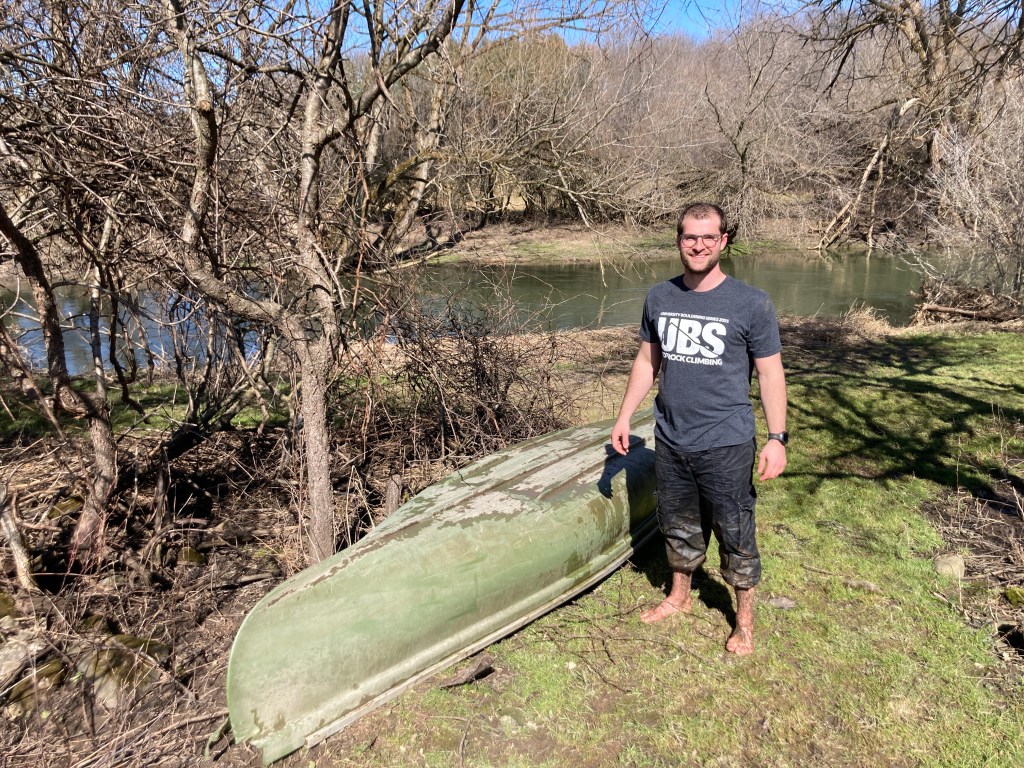
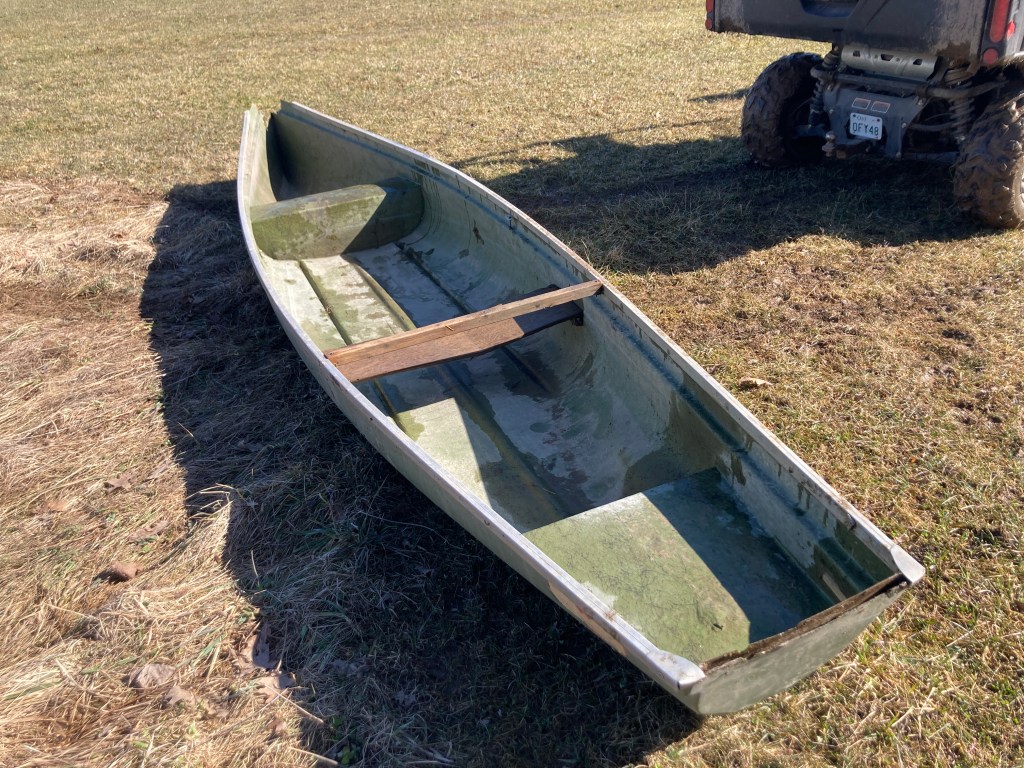
We decided to call her the Green Bean, for obvious reasons. Now, I just had to fix her up to travel 300 km down the Thames. I’ll leave the rest of this story for another blog.
Part 2: The Murders
I continued my journey North using Google Maps, curiously following the rivers up to find out how they made it to the ocean. I started googling the places that I saw as I went through the different locations. Eventually, I hovered over the Hudson’s bay and ended up finding the barren Belcher’s islands. I did a quick Google search, and what I found shocked me.
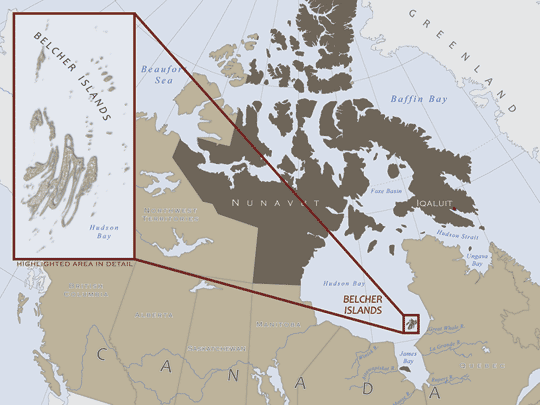
The Belcher’s islands had been the site of a disturbing cult-like hysteria that resulted in the deaths of 9 people (out of a population of 150-200 people). In the Winter of 1941, the islands had been going through a scarcity of food (they relied on seal hunting). During a meteor shower in January, wannabe village shaman named Charlie Ouyerack declared that the second coming of Christ had begun. He claimed that he was Jesus and that the best hunter in the village, Peter Sala, was God. As wild as these claims were, most of the people in the village accepted them. In preparation for the end of the world, they executed all the sled dogs, claiming they were no longer needed. Over the next couple of months, 3 people who did not show adequate belief in the new deities were savagely beated and shot to death. At the end of March, 6 more people were killed when they were forced out on the ice by Peter Sala’s sister, Mina. She claimed that Jesus was coming to meet them. The 6 people, which included 4 children, died of exposure. Brutal.
The best source of information I found on this topic was “‘Religious Frenzy’ and the Application of Canadian Law” by Corah Lynn Hodgson and P. Whitney Lackenbauer. They laid down the facts and arguments in a very methodical way, including every detail of the legal case that followed. A combination of factors led to the events. For one, desperate times may have made the people more susceptible to extreme ideologies. They also had a strange belief system that mixed shamanism with biblical teachings. The community had received bibles and some decades earlier, but hadn’t been visited by a missionary for 17 years due to the remote location. Left to their own devices, they came to zealously believe their own interpretation of the bible and when the conditions were ripe things got out of hand.
To investigate and resolve the case, the Canadian court came to the islands (the court proceedings were actually held in a tent). The results of this seemingly open and shut case were equally as crazy as the events that preceded it. One murderer was acquitted for “temporary insanity”. Four, including Ouyerack and Sala, were brought down from murder to manslaughter, and Mina was judged insane and unfit to stand trial. Altogether, nobody served more than 2 years, and one even got a pardon to so he could hunt for the village. Apparently the reason for these outcomes was that the judge, Plaxton, liberally made arguments to the jury about his own opinions of the case (he tended to see the Inuit as a less evolved humans, that were too innocent to deserve harsh punishment). In the end, however, the imprisonment was much more of a punishment than it seemed. The exposure to new diseases at the prison resulted in continual poor health for almost all of the convicted. Ouyerack even died of tuberculosis a year after the trial.
Part 3: The Pimple
Continuing my journey East through the bodies of water, I ended up in Northern Quebec and happened to come across another spectacular finding. Near Donaldson, I noticed a completely circular lake in Pingualuit National park. It turns out that this is called the Pingualuit crater, the name coming from the word “pimple” in Inuit. The crater lake is 3.44 km in diameter and was formed by a meteor impact 1.4 million years ago. Because of the raised ridge surrounding the lake, it only gets water from rain and snow, so it’s has some of the purest fresh water in the world. Check it out:


I had no idea anything this otherworldly even existed in Canada (I also didn’t know how big Quebec is — turns out it’s the largest province in Canada).
Thank you for reading. I hope you enjoyed some of these things I found during my internet escapades. If you’re ever itching for an adventure, but you’re stuck inside, I recommend trying this as a temporary fix. It can lead to some surprising discoveries and you may even find leads for amazing future adventures.
 Luke Tambakis
Leave a comment